

'Stay True' to the game
Nº 018

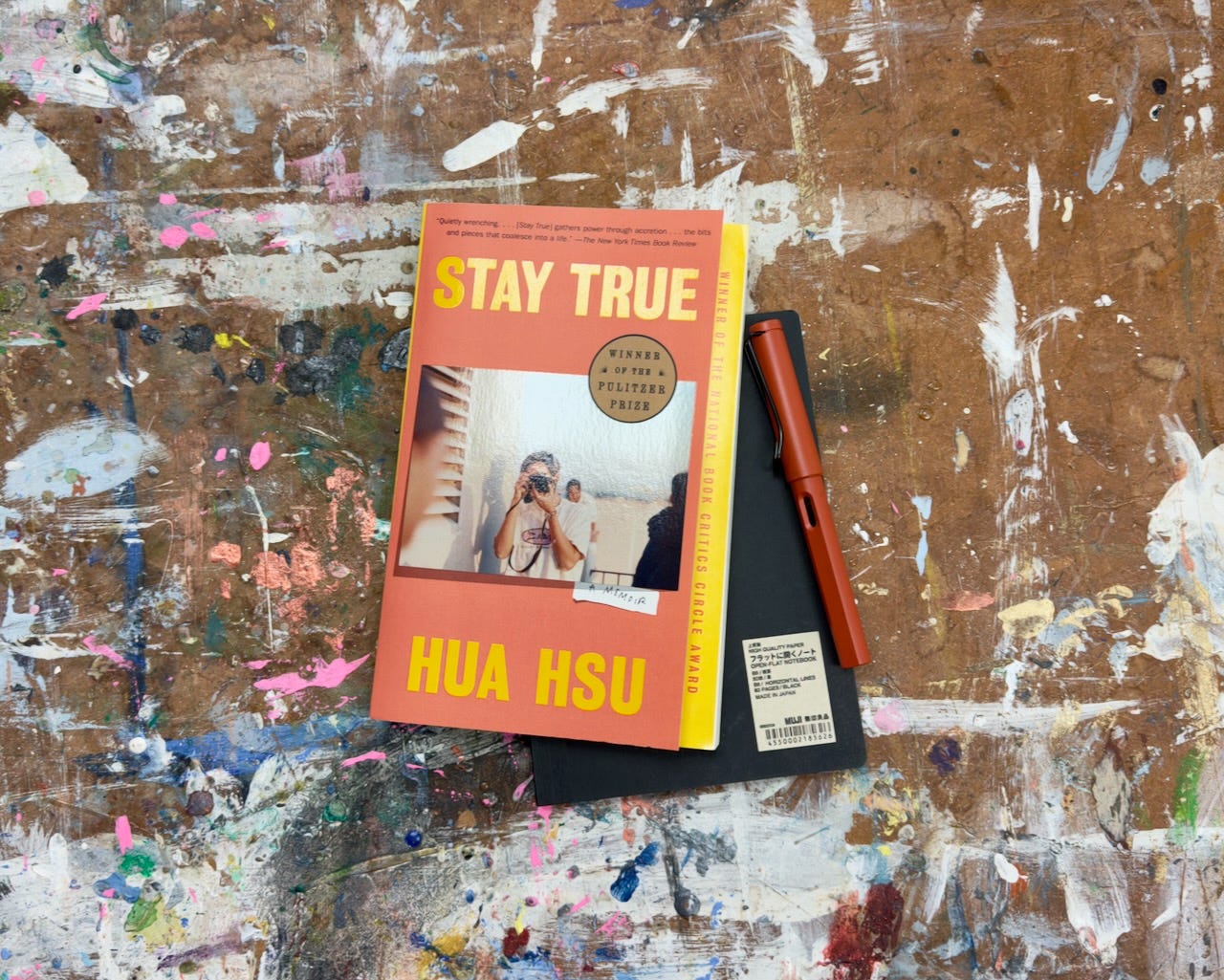
I bought the book Stay True (Doubleday, 2022) by Hua Hsu when it first came out. I remember setting it on a counter and meaning to start right away. Instead, I loaned it to a friend. He read it and brought it back. Another friend picked it up not long after and never returned it. Eventually, I bought a second copy.
I knew I wanted it to be the first book I read this year. I picked it up late one night last week, after work, after the house went quiet. I told myself I would only read a few pages. I told myself I was tired. That turned out to be false.
The room smelled of leftover pizza warmed up in the microwave. A hard drive hummed in the background. Outside, a car passed every few minutes, tires whispering on asphalt. I sat there longer than I expected, reading slowly.
The book opens in a world I recognize. The mid-1990s. Music that felt like a map. Identity built from taste. Refusal as posture. In the late 1990s, I lived in San Jose for a brief time, not far from where this story took shape. I didn’t go to college, but I knew this world anyway. During those days, I hung out in record stores like Amoeba and Rasputin. I drank cheap beer in bedrooms with friends, late-night gaming sessions, and conversations that went nowhere and meant everything.
The book went on to win the Pulitzer Prize for memoir and the National Book Critics Circle Award, and it landed on The New York Times’ list of the year’s best books. In it, Hsu traces his upbringing as a second-generation Taiwanese American and how identity and taste shaped his movement through college. He writes about arriving at Berkeley in 1995 and finding his footing through music, ideas, and distance.
In those days, I learned to define myself by exclusion. What I didn’t like mattered more than what I did. I used musical taste as a filter. Same with books and films. The more obscure the better. The goal was defined. The cost was connection.
Hsu writes about friendship forming across differences. He writes about meeting Ken in college. He writes about how they didn’t share the same posture. Ken was lighter. More open. Less guarded. Their friendship didn’t come from shared rejection. It came from proximity and time. From showing up.
Most of my friendships back then were formed around convenience. Coworkers on the same shift. People I saw every night because we clocked out together. Having a car. It felt safe. It also felt fragile. When something changed, friendships often cracked.
The book moves through these years without rushing. It observes. The restraint it shows made me realize how long it took me to understand who I was. I didn’t figure it out in my twenties, and I am still working it out now in my fifties.
Music sits at the center of the book. Not as nostalgia, but as evidence. Songs as markers of time. Albums as emotional storage. I remember buying CDs with money I didn’t have and reading liner notes like scripture. I remember using music to keep people out. Hsu writes about that impulse without defending it. He lets it sit. The book doesn’t suggest that taste saved him. It suggests that friendship did.
About halfway through the book, grief enters the room. Ken’s death breaks the shape of the story without turning it into a spectacle. Hsu doesn’t rush to meaning. He documents the aftermath.
That approach felt right to me. Last year, my nephew died by suicide. We hadn’t been close for years. The distance felt manageable until it wasn’t. After his death, I found myself looking backward, searching for missed signals. There were no clean answers. I think about him every day now.
While reading Stay True, I recognized the urge to document. To inventory memory. To hold on to details because they feel safer than conclusions. Grief doesn’t want lessons. It wants a witness. After my nephew died, I kept his journals as evidence of his pain. I keep mine as evidence of my existence.
Hsu returns again and again to the idea of friendship as something shaped by time, not intention. You don’t choose every bond. Some form because you sit near each other long enough. Some survive because no one leaves.
In my twenties, I believed friendship required alignment. Shared values. Shared taste. Shared anger. The book reminded me that friendship can also be uneven and still be real. It made me think about my current friendships and the differences between us.
There’s a quiet political thread that runs through the book without ever taking it over. It never dominates. It lives in the background, where it belongs. Questions of identity. Assimilation. Who gets to belong without explanation. Hsu doens’t perform these ideas. He lives them.
As a Gen X kid from a working-class background, I saw a different version of that struggle. Ours was less about assimilation and more about how we carried ourselves. We distrusted institutions. We believed detachment equaled intelligence. That belief followed me into adulthood and shaped how I hold people at arm’s length.
The writing itself is clean and precise. Nothing flashy. Nothing wasted. Sentences do real work. I read the book in two sessions over a weekend.
What stayed with me most was the way the book treats memory. Not as something fixed, but as something that shifts each time you touch it. Friendship changes in hindsight. Loss rewrites the story without asking permission. Hsu questions his friendship with Ken. Were they really that close?
I started thinking about my own friendships from that era. The ones that lasted. The ones that fell away. The ones I abandoned without meaning to. I thought about how often silence stands in for care.
There is a line in the book about the many currencies of friendship. I didn’t need it spelled out. I saw it in my own life. Time. Attention. Forgiveness. Patience. Those things matter more now than taste ever did.
I used to believe that staying true meant staying sharp. Staying critical. Staying separate. This book suggests something else. That staying true might mean staying open. Staying in the room longer than feels comfortable.
The book doesn’t wrap grief in meaning. It doesn’t offer closure. It leaves space. I respect that. Some losses don’t resolve. You carry them forward without explanation.
When I think about my nephew now, I think less about what I missed and more about what distance does to people. How easy it is to mistake quiet for stability. How often we confuse absence with choice.
Stay True doens’t tell you how to grieve. It shows what it looks like to live alongside grief without turning it into a story about strength. That restraint feels right.
By the end of the book, I was thinking less about the 1990s and more about now. About how friendship works when you are older. When time feels thinner. When everyone is tired.
Friendship now looks like checking in. Listening without fixing. Allowing people to change without demanding an explanation. I’m not always good at that.
When I finished the last chapter, I closed the book and left it on my desk. I didn’t put it back on the shelf right away. It felt like something I might need again.
Outside, the street was quiet. I sat there longer than I needed to. Thinking about the people who stayed. Thinking about the ones who didn’t.
Friendship, the book suggests, is not about being right. It is about being there. That feels harder now than it did in the 1990s, but it also feels more necessary.
I turned off the light and left the book where it was. Not finished with it. Not finished with the questions it raised. It made me want to be a better friend, and that felt like the right place to stop.
cp out.